

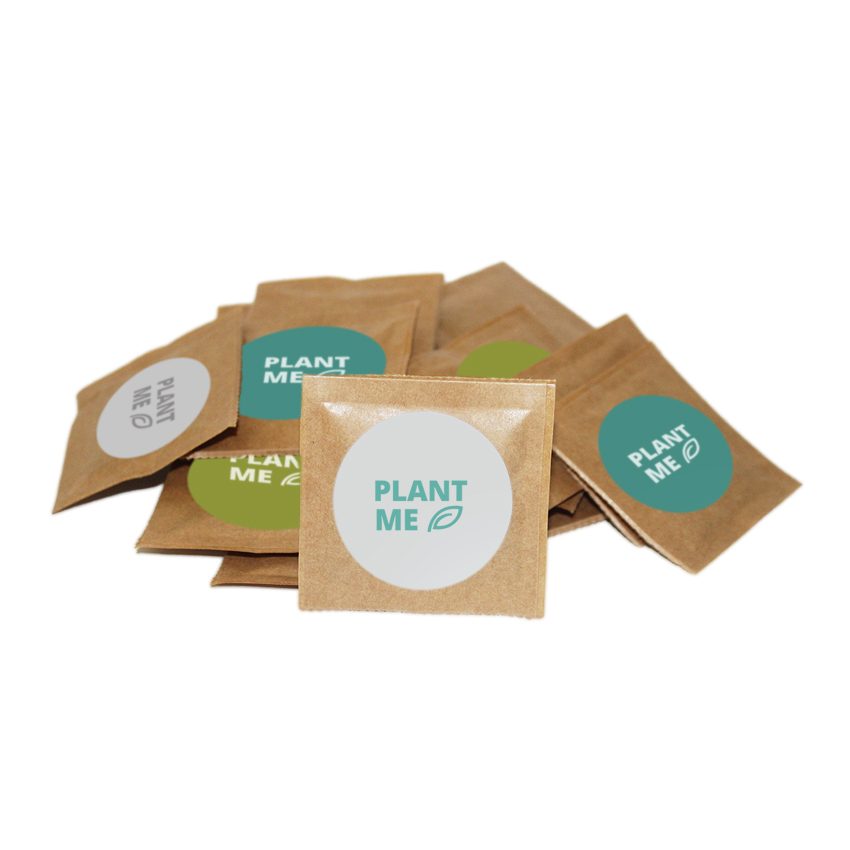
Most trade show gifts do not survive the walk from the hall to the car park. This post covers the difference between a giveaway and a gift, what fits in a goody bag and what does not, why a small item in a large quantity works better than an expensive item in a small quantity, and what to print so that the object still means something a week after the show.
A giveaway and a gift are not the same thing
These two are confused with each other, and most of the wasted budget comes from that. They solve different tasks and therefore have different correct quantities, prices and prints.
- A giveaway is a device that makes a person stop. It is given to a stranger, the quantity is large, the unit price small and the decision is made in a second. Its job ends the moment a conversation has started.
- A gift is a device that leaves a trace. It is given to someone you have already talked to, the quantity is small, the unit price higher and it is handed over by name. Its job only begins after the show.
From this follows the most common mistake: one mid-priced product is bought in the hope that it will fill both roles. For a giveaway it is too expensive, so it gets rationed and there are fewer contacts; as a gift it is too generic, so at the end of a serious conversation there is nothing to mark that conversation. The mid-priced product loses at both ends at once.
The practical conclusion: take both with you, but in different quantities. A large pile of one cheap item on the counter and a small box of something better under the counter for the people who actually sat down. If you have only one product, then either you give it to the wrong people or you do not dare give it to anyone.
What fits in a goody bag and what does not
Anything going into a conference goody bag has to pass three filters: it has to fit, it must not weigh anything, and it must not create a single extra decision for its owner. The third is the one people think of least often — anything that makes a person wonder “where do I put this now” flies out at the first bin.
- Fits: flat, light, no glass and no liquid. Seed paper and seeded print products are the extreme example here: they are essentially a piece of paper, but they are not thrown away like a flyer, because they have a later use.
- Fits conditionally: small boxes and cups. They work if the person can put them on a desk. At a large trade show, where the visitor has already been on their feet for three hours and is carrying two bags, every centimetre is a matter of negotiation.
- Does not fit: anything fragile, heavy or an awkward shape. For a visitor flying home there is one more filter — hand luggage.
A separate dimension is whether the item reaches home in one piece. A goody bag usually spends the rest of the day underfoot, travels in a car or on a plane and is only emptied the following morning. A product that has to survive that journey must not crease or spill — a sealed box or a print item in solid packaging tolerates that treatment far better than a loose pack.
If the bag is packed by the organiser, it is also worth asking how many items go into it altogether. Among thirty objects, standing out is a question of content, not of size.
Why a small item in a large quantity works
At a trade show the aim is not to impress one person but to reach many and keep a connection with some of them. A small item in a large quantity gives three advantages at once.
First, you dare to give it away. An expensive item starts being held back at the counter, and the result is that at the end of the day the box is half full and there are fewer contacts than there could have been. Second, a larger quantity works in your favour on the print thresholds: full-colour printing on the box starts from 500 pieces and direct printing on the cup from 1000 pieces, so trade show quantities often land exactly where the better printing options open up. Third, the surplus is usable — seed balls and growing kits do not spoil, because a sealed kit keeps on the shelf for up to several years and the process only starts after it is opened and water is added. Whatever is left over from the show goes along to a client meeting the following month.
The same logic works with a pencil: a pencil with seeds fills the role of an ordinary pencil throughout the show, and only when it runs out does the second half of its life begin. That is a rare quality — most promotional gifts turn into rubbish when their use ends, not into a beginning.
What to print so it still counts after the show
The most common mistake is to print nothing but a logo on the item. A logo says who gave it, but not what to do with it. A week later, when the thing is already on somebody’s kitchen table, your stand is no longer in their memory and a logo on its own will not bring it back.
Four things that genuinely do some work in a short print area:
- One specific action. If something has to be done with the product — opening, adding water, waiting — then write it out. Our kits have a short set of instructions under the lid, but it is the one sentence on the outside of the box that makes a person open that lid in the first place.
- Time. Germination takes from a few days up to about twenty days, and herbs such as thyme are the fastest. If a person knows that the first result takes weeks, they will not give up on the third day.
- One line of text that ties it to the show. The name of the event and the year turn a generic object into a memory of a specific day. This is also the only place where printing a date is useful rather than limiting.
- One way back. A short address or a QR code pointing to one specific page, not to the home page. Anyone returning two weeks later has already forgotten what they were looking for.
The choice of printing method depends on the product: full-colour printing on eco paper or kraft paper gives the most room for text, engraving on wood and on pencils is quieter and more durable, labels and box sleeves are more flexible at a smaller quantity.
A timeline that prevents panic before the show
The date of the show does not move, so count backwards. Orders are fulfilled within up to 10 working days, and the first digital design proof is free, without obligation and ready within one day. The real time cost is usually not production but how long it takes to agree the design inside your own company — plan a separate slot for that, not inside the production time.
If the fitting-out of the stand itself is also on the table, it is worth reviewing eco office supplies with the same order, because the pencil handed to visitors and the pencil used on the stand can be the same product with the same print.
Before sending an enquiry, write down three numbers: how many people pass your stand, how many of them sit down, and by what date the goods have to be there. The answers to the other recurring questions are collected on the questions and answers page, and if you send us those three numbers you will get back a proof on which the decision can be made.