

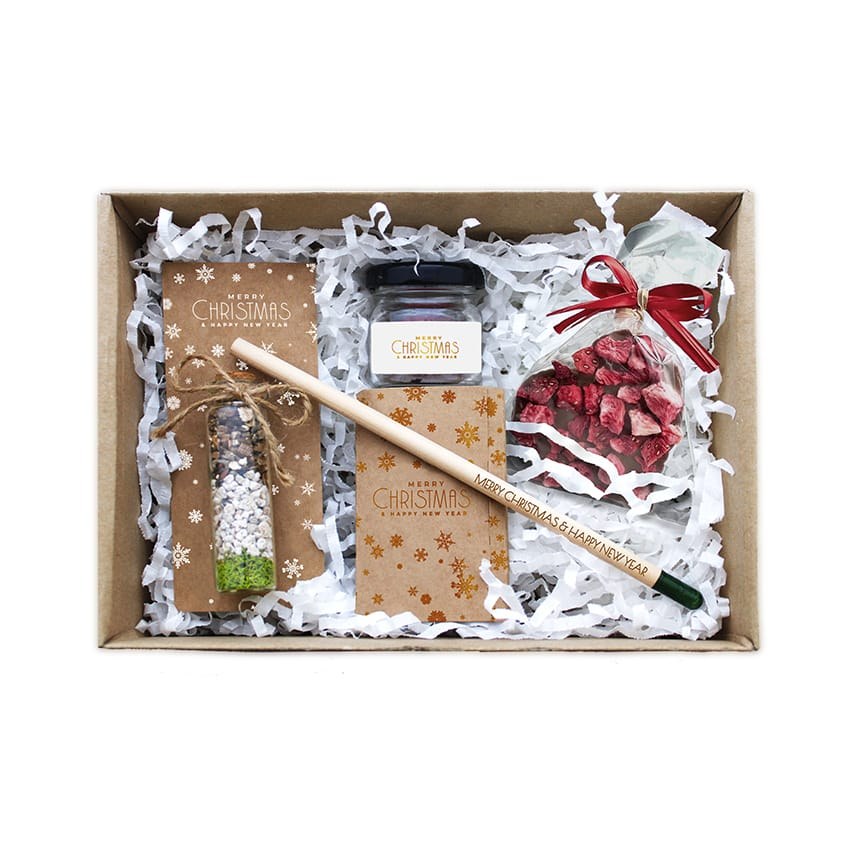
Ordering corporate gifts with a logo is clearer when the quotation request describes recipients, products, quantity, artwork, packaging and required arrival. A photograph or a wish for something green can communicate an idea without defining a comparable order. A useful brief helps select an option, resolve questions and approve the right proof. Distinguish fixed requirements from decisions where you want advice.
The photograph shows a manufacturer’s sample design. Your order contents and artwork are confirmed separately.
Start the branded-gift order with its use
Identify who receives the gift and at what moment. An event giveaway, employee welcome set and partner thank-you gift serve different needs. Explain whether the item is handed over directly, placed in a gift bag or shipped. This helps compare complete products and their presentation, rather than relying on how they look in a photograph.
If the product is undecided, state two or three practical limits. It may need to fit an existing bag, include a growing activity or accommodate an approved logo treatment. Compare a growing kit, seed paper or a set with your selected products around those requirements. Important constraints should be known before the final artwork round.
Identify the priority. Put a fixed arrival requirement at the start of the brief; do the same for a mandatory product or marking. This makes alternatives easier to assess when all preferences cannot be combined. The quotation confirms a particular solution for your situation, rather than merely repeating a generic product example.
Split quantities by product and artwork version
Record recipient numbers, order quantity and any planned reserve. Calculate distribution for each event and check the total. Recipient count and product count differ when each person receives a set. For a set, both the number of complete sets and the quantity of each included item matter.
| Brief line | Detail to specify |
|---|---|
| Product or set | Actual model or component list |
| Quantity | Number of pieces or complete sets |
| Versions | Different logos, wording, colours or packaging |
| Locations | Where and how many products are needed |
| Schedule | Required arrival and artwork approver |
Separate quantities for different languages, logos or packaging. One large total does not automatically combine the production conditions for every variant. Minimums, pricing and feasibility depend on the particular product and treatment. Explain the required split and have it confirmed in the quotation before completing the designs.
Send the logo and package wording with a clear task
Supply the best original logo file available. Distinguish a concept example from a production file. An example describes the idea; the model’s template and printing area still need confirmation. Dimensions taken from a photograph or another product’s proof are insufficient. Give the designer the same brief and agreed starting information.
Name the marking required on each part: product, card, wrap or box. Printing, engraving and labels are not interchangeable across every model. State compulsory brand colours and include an approved single-colour logo where useful. Request the appropriate treatment for each surface rather than simply asking for the same logo everywhere.
Provide package wording with spelling, web address and language versions checked. Identify who can approve it. A late wording change can affect layout or version count. Use filenames identifying the part, language and version. The approved proof needs to be distinguishable from an earlier concept so both sides refer to the same arrangement.
Distinguish production from required delivery
State when the finished order must reach you and give the destination country or receiving point. An event date alone does not show whether you need goods earlier for assembly or distribution. For several locations, provide the desired split and request the delivery arrangement explicitly. A list of locations does not automatically create several shipments.
The schedule includes choosing products, checking files, approving artwork, production and transport. Allow your company time to make decisions and name the approver. Sending a file does not mean it is feasible or approved for production. Exact timing is confirmed for the order, rather than inferred from a general suggestion to plan a number of weeks ahead.
For a close deadline, describe what can change: product, packaging or extent of marking. Request a concrete option to be assessed, then confirm the complete arrangement. The earlier Christmas-order timing guide explains the general sequence, while your arrival date still needs confirmation for the actual quotation.
Check the full quotation before approval
Compare it with the brief. Are models, quantities and versions correct? Does it include the intended marking, packaging, assembly and transport? Which preparation work or taxes are shown separately? Place component lists beside each other when comparing alternatives. A total price alone does not establish equal contents.
Resolve open questions before final artwork approval. A substituted item may affect the set photograph, package wording or marking method. For a repeat order, provide the previous reference and distinguish unchanged parts from changes. A new order for the same named product still requires confirmation of quantity, contents, design and schedule.
Explore the gift-set collection and the corporate gift-set guide. The personalisation guide helps with marking choices. Send your quotation request with the brief, or use the chosen product’s form. Clear starting information makes the first reply more useful and provides a basis for approving the appropriate order.
More selection guides
- When to order Christmas gifts so they arrive on time
- How personalisation really works: print, engraving, label
- Corporate gift sets: a ready-made option or your own selection?