

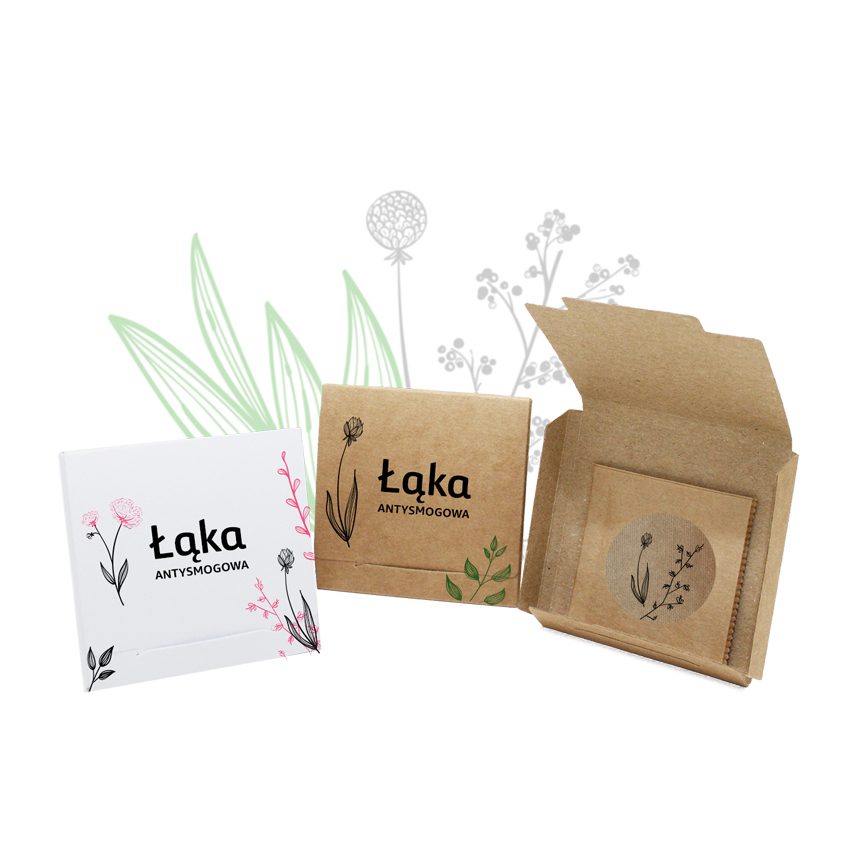
A “green gift” is not a property of a product but a claim — and a claim is something you have to be able to repeat when someone asks on what grounds. Here you will find what a sustainable corporate gift means in practice, which questions to choose by, which claims a supplier can substantively cover and which not, and how to avoid greenwashing even when the intention is good.
What a “green gift” really means
To carry a company’s environmental message, a gift has to answer three questions at once, not one.
What it is made of. The material is the only part that can be checked immediately and spoken about specifically: paper, wood, glass, plant wax, seeds, humus. It is also the only part most buyers decide on.
Whether it is used. This part is usually skipped, although it matters more. An object made of eco material that nobody ever picks up is still an object that nobody picks up — the material changes only what happens after it is thrown away, not whether it is thrown away. A gift with an activity built into it (opening, watering, eating, growing) lives longer than a gift that only has the right material.
How much of it is ordered. The biggest environmental impact usually lies in excess quantity. An order of which part sits in a warehouse and is thrown away the following year is a worse outcome than a smaller quantity that is handed out in full. The quantity is also the only part of the decision that depends on you alone — the supplier decides on the material and the production, not on the quantity.
What to choose by: six questions before ordering
These are the questions worth asking the supplier and yourself before the quantity is confirmed.
- What does the product actually consist of? Ask for the materials part by part — product, packaging, label, filling. Most often the environmental message trips over the packaging rather than over the product.
- What will the recipient do with it? If the answer is “put it somewhere”, the gift is already half lost. If the answer is a verb, the story is better.
- Can the gift bear waiting? A gift that spoils within a week or demands action straight away creates an obligation. A sealed growing kit, for example, keeps on the shelf for up to several years and the process only starts once the recipient opens it and adds water.
- Does the personalisation last as long as the product? An engraving on wood lasts the lifetime of the product; a sticker is gone within the first week. If the logo disappears before the product does, the object remains but the message is gone.
- Does the quantity match how much you actually hand out? Look at last year’s figure, not at the optimistic plan.
- Can you justify the choice in one sentence? If the justification takes a paragraph, it is not a justification but an excuse.
Which claims are covered and which are not
The simplest way to avoid greenwashing is to separate two kinds of claim: those the supplier shows you on the product itself, and those that require a document or a calculation. The first kind you may safely repeat in your own communications, the second kind you may not.
Usually covered are composition and material (“the packaging is kraft paper”, “the box is eco paper”, “the label is kraft paper”, “the ball contains seeds and humus”), the method of personalisation (“full-colour printing on eco paper”, “engraving on wood”) and what happens with the product (“a plant grows from the seed”, “the kit is opened and watered”). These are verifiable, because they are the product itself.
Not covered is everything that is a calculation or a certificate: climate neutrality, a CO2 footprint figure, the share of recycled material in per cent, compostability under specific conditions, supply chain audits. These are not automatically false — but they must not be written into your ESG material without evidence that the supplier has given you separately. If you have not seen the document, you have not seen the claim.
A practical rule: describe the act, not the impact. “We gave our staff seed balls of bee-friendly plants” is a verifiable sentence. “Our gift helped to save the bees” is not.
Four ways in which well-intentioned greenwashing happens
Most greenwashing is born not of ill will but of haste. These are the typical places where it happens.
The supplier’s marketing text is copied into the report. Catalogue text is written to sell, not as evidence, and it may name a material that the particular product does not contain. Copy over only what the product description specifically confirms, and if something remains doubtful, ask the supplier directly — you are allowed to ask us about what we do not have as well.
“Biodegradable” without the conditions. Most materials break down in some conditions and do not in others. If you do not know which, leave the word out and simply name the material.
One green gift carries the whole message. If the gift is the only environmental act a company puts forward, the contrast is too great and the reader notices it before you do. A gift works when it is a smaller part of a bigger thing that you are doing anyway.
The message is on the packaging but not in the accompanying note. The recipient will not work out for themselves why you chose this particular one. One sentence about why the gift is what it is does more than a second logo on the other side of the packaging.
Gifts that carry the message without spelling it out
The strongest environmental message is the one the recipient discovers for themselves while using the gift. In our range the categories that work most clearly in this role are these:
- Growing kits — for a named, personal gift. Each kit contains several seeds and a short instruction under the lid; germination takes from a few days to a couple of dozen days, and the quickest are herbs such as thyme.
- Seed gifts — for a large quantity, for a trade fair and to slip into a customer letter, where the gift has to be light and free of obligation for the recipient.
- Eco office supplies — for where the gift is used every day and the logo has to last as long as the object.
- Eco food gifts — when the gift definitely has to be used up rather than left in a cupboard.
The common thread is that all of them have an activity in them. The activity is the reason a gift is remembered even a month later, and at the same time the only thing that separates a sustainable gift from a piece of merchandise made of eco material.
How ordering works in practice
There are no prices on our page, because they depend on the quantity, the product and the printing — asking for a price goes through an enquiry and the answer comes together with the lead time. We fulfil orders within up to 10 working days; in season it is worth allowing for that time with a margin, because most gifts end up late not because of production but because of decision-making.
Before confirming you can see what you are ordering: the first digital design sample is free, without obligation and ready within one day. Write into the enquiry the quantity, who the gift is going to and by what date it is needed — then we will say what fits into that frame and what we cannot claim on your behalf.