

When you choose between seed paper, a seed ball and a growing kit, you are not really deciding on looks. You are deciding on three things: how much print area you get, how much work is left to the recipient, and how long it takes to reach the first visible result. These three products are not three sizes of the same thing — they solve different tasks and are rarely interchangeable.
Seed paper: the largest print area
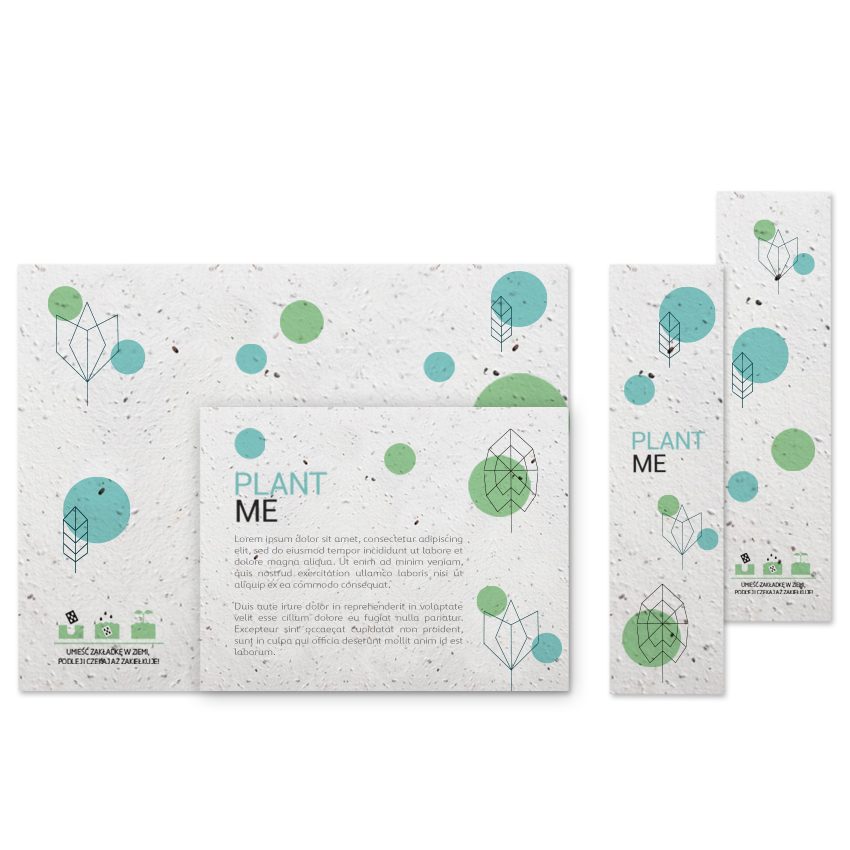
Seed paper is paper with seeds already embedded in the pulp during manufacturing. From a gift point of view that means one thing: the entire surface is print area. A card, an invitation, a price tag, a covering letter, a gift card sleeve or a leaflet handed out at a trade show can carry full-colour printing on eco paper or kraft paper and still be plantable.
That is exactly why seed paper suits situations where the message matters more than the object. If you need to deliver an invitation, a thank-you or a short story and you do not want that paper to end up in the bin, then seed paper and seeded print products are the only one of the three that can hold a longer text and several languages at once.
The weak spot, to be honest, is that paper on its own is not a gift. It is a good companion, not the lead role. Seed paper gives the most when it travels with something else: a card on top of a gift box, a tag attached to a product, an invitation inside the event packaging. And it has to be kept dry — moisture starts the process before the recipient has even opened the envelope.
Seed ball: the lowest threshold
A seed ball is a ball pressed together from soil and seeds that the recipient simply puts on the ground. There is no pot, no watering schedule, no instruction leaflet that nobody reads. Of the three it is the product with the lowest threshold: someone who does not consider themselves a gardener and has no pot on the balcony will manage with it.
The ball itself, however, has no print area. You cannot print on a pressed soil surface — all the personalisation goes onto the packaging, the pouch or the label. That means seed balls work best with a larger quantity and a simple message: a logo, one sentence, one colour. If the plan involves a long text, a campaign QR code and three languages side by side, the surface becomes cramped and the design turns illegible.
The other thing worth allowing for is the season. The ball usually goes outdoors and its result depends on the weather more than any of the other two. A ball handed out in November waits until spring — that is not a fault, but it does mean you will not get feedback about your gift any time soon.
Growing kit: the only one that stands on its own
The growing kit is the only one of the three that works as a gift in its own right. The box or cup contains the growing medium, several seeds and a short set of instructions under the lid — the recipient does not have to buy anything extra or search online for what to do with the thing. Sealed, the kit keeps on the shelf for up to several years, and the process only begins when the recipient opens it and adds water.
That shelf life is a practical advantage which paper and balls do not offer. Corporate gifts are bought in advance, handed out unevenly, and some of them stay in the cupboard until the next event. A growing kit tolerates this without anyone having to write anything off.
The print area is also more generous than on a ball: you can use the box, the sleeve, a label and the wooden parts, which take an engraving well. Some solutions only open up as the quantity grows — full-colour printing on the box starts from 500 pieces and direct printing on the cup from 1000 pieces. With a smaller quantity you do not lose the personalisation; it is simply solved with a label or a sleeve instead. Growing kits are therefore the usual choice when the gift has to mean something on its own on arrival.
The comparison in one table
| Seed paper | Seed ball | Growing kit | |
|---|---|---|---|
| Print area | The whole surface, full-colour printing on eco paper or kraft paper | Packaging, pouch or label only | Box, sleeve, label, engraving on the wooden parts |
| How much text fits | A lot — an invitation, a story, several languages | Little — a logo and one sentence | A medium amount — logo, message and a short instruction |
| What the recipient has to do | Put the paper in soil and water it | Put the ball on the ground | Open it, add water, follow the instructions under the lid |
| Keeping before use | Needs dry storage | Needs dry storage | Sealed, up to several years on the shelf |
| When the result arrives | Germination from a few days up to about twenty days | The same range, but depends on the weather and the season | The same range indoors, herbs are the fastest |
| Works as a gift on its own | Not really — a good companion to something else | Not really — good for handing out in large quantities | Yes |
| Typical use | Invitation, thank-you card, trade show print, product tag | Trade show, conference, street event, large quantity | Christmas gift, gift for staff, client gift |
Four situations and a recommendation
- A trade show or conference, many contacts, a small budget per contact. A seed ball or seed paper. The ball if you want the person to do something themselves; the paper if you have a message to read.
- An invitation, a thank-you card or a note inside a parcel. Seed paper. It is the only one of the three that carries text and can be planted after reading.
- A Christmas gift for an employee or a long-standing client. A growing kit. An object in its own right, a long shelf life and an activity for the recipient that lasts weeks rather than a moment.
- A gift for someone whose interests you do not know. A growing kit with a herb. Thyme and other herbs germinate faster than most other seeds, so the result arrives sooner and the gift does not hang in the air.
What happens in the recipient’s hands
With all three the real part only begins after water is added. Germination takes from a few days up to about twenty days, depending on which seed is inside. Herbs are the fastest, which is why a gift made with them also reaches your feedback soonest — if it matters to you that a colleague sends a photo in January, that is an argument.
A growing kit always contains several seeds, so one failed attempt does not mean a failed gift. With seed paper and seed balls the result is more at the mercy of the season: both usually go outdoors and depend on light and watering more than a sealed kit with its lid does. If you need the gift to work on an office desk during the dark half of the year, the choice leans towards the kit. If you want something to be left in the garden or on the balcony in spring, it leans the other way. The rest of the range — from pencils to live plants — can be found under seed gifts.
If the choice has narrowed to two options, the quickest way forward is to send an enquiry with the quantity and the message you want: the price depends on the quantity and the printing technique, so a general price list would be of little help here. The first digital design proof is free, ready within one day and commits you to nothing — you see your logo on the product before you decide anything. Orders are fulfilled within up to 10 working days, so with plant growing kits it is worth putting that time into the calendar in advance during the season.