

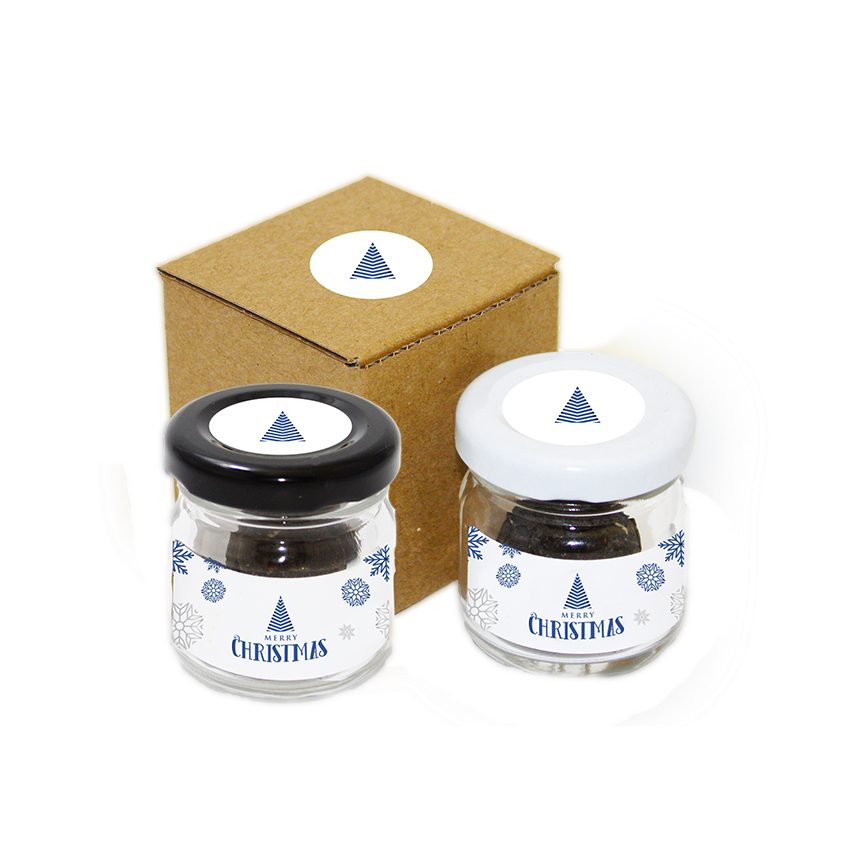
A seed ball is a ball moulded from humus and the seeds of bee-friendly plants, which the recipient throws onto the soil and then forgets — the rain does the rest. Below is what is really inside the ball, why a mixture of bee-friendly plants makes a difference for bees, how the gift works in the recipient’s hands, which packaging options exist and when an order like this makes sense.
What a seed ball is and what is inside it
A seed ball contains two things: the seeds of bee-friendly plants and humus. The seeds are what the flowers grow from; the humus is a starter portion of nutrients and at the same time the material that holds the seeds together and in place. The ball therefore does a job that an open packet of seeds does not — the seed does not blow away in the wind or fall straight to the birds, but stays where it was thrown until the weather opens it up.
The recipient does not have to do anything for it to break down. The ball disintegrates by itself in the damp, the seeds stay in the soil and the humus gives them a start. It is exactly this difference that makes the ball a better gift than a packet of seeds: the packet demands a decision, time and usually a flowerpot as well, the ball does not. A gift that demands no decision does not sit in a drawer waiting for the right moment.
Seed balls can be thrown into a garden, onto a neglected flower bed, into a city park or simply into a flowerpot on the windowsill. No gardening skills are needed — with a gift that is an important detail, because you never know in advance whether the recipient has a garden, a balcony planter or only a windowsill.
Why a bee-friendly mixture and not just flower seeds
Bee-friendly plants are those flowering plants that give bees nectar and pollen. Not every pretty flower does that: many ornamental varieties from the garden centre have been bred for dense blooms and a long flowering period rather than for food, and a bee often simply cannot get inside a double flower. A mown lawn is empty land for a bee.
The point of a seed mixture is that the plants do not all flower at the same time. If the mixture contains species that flower at different times, there is food to be found in the same patch for longer than one week, and it is precisely the gaps that are the biggest problem in an urban environment — in spring a great deal flowers at once, in the middle of summer a hole can open up.
It is only fair to say what a single ball does not do. One seed ball will not save the bees or replace a meadow left unmown. It makes one small patch. On the scale of a corporate gift the arithmetic changes, however: when the balls go into hundreds of hands at once in different towns, many small patches appear, and what matters for a bee is precisely that the feeding points are not too far from one another.
A practical limitation worth writing into the accompanying note: a mixture of bee-friendly plants wants sun. A ball thrown into a shady corner grows mostly disappointment.
How the gift works in the recipient’s hands
The whole activity is two steps: put the ball on the soil or in a flowerpot and water it. There is no need to dig, because the seeds do not want to go deep. The best time is spring and early summer, but in a dry place the ball keeps until the next season — which means that a ball given in December is not wasted either, it is simply waiting for spring.
Three places where the ball will not work are worth stating in the accompanying note: asphalt and gravel, deep shade, and regularly mown lawn — the last one is the most insidious, because the plant comes up but the mower takes the flowers off before they bloom. Everything else, including the most ordinary balcony planter, is suitable.
The most common reason such a gift goes unused is not a lack of interest, but that the recipient does not know what to do with it. That is why the planting instructions go on the back of the packaging. One sentence about when and where to throw the ball does more than half of the gift.
The packaging decides how expensive the gift feels
The same ball can be a token of attention slipped into a letter or a gift standing on a desk — the difference is in the packaging. The choice is roughly this:
- Cardboard sleeve — the thinnest and cheapest. Fits inside a letter, suits a large quantity and posting.
- Cardboard box — more print area, stands upright on a desk. Good for a trade fair table and a gift bag.
- Jute bag — reads as the most natural to the touch, when the feel of the material is part of the message.
- Glass jar — stays with the recipient even once the ball is already in the soil. Suits a named, personal gift.
- Four balls in a set — the choice when the gift has to be a gift, not a token of attention.
Besides the ordinary balls there are coloured versions, where the colour of the ball matches the colour of the plants inside it and you choose the mixture yourself. This is a simple way to tie the gift to a brand colour without having to print anything extra.
Printing and personalisation
Full-colour printing goes on all the packaging, the material being white eco paper or kraft paper, with the planting instructions on the back. The limit stated on the products is that full-colour printing on a box starts from 500 pieces — with a smaller quantity it is worth saying so straight away in the enquiry, and then we can offer packaging that suits your quantity.
You do not have to order a design blind: the first digital design sample is free and without obligation, and is ready within one day. It shows whether the logo, the text and the planting instructions fit onto the chosen packaging the way they should.
The print area is also where the ball differs from its close relatives. With a seed ball the message is carried by the packaging, not by the product itself — if you want the logo and the text to be on the product itself, seed paper or an engraved pencil is the more direct choice. The difference is small, but it decides whether the gift still works once the packaging has been thrown away.
If you are weighing up several options at once, it is worth looking at the whole range of seed gifts together. Pencils with seeds solve the same message where the gift has to be usable straight away, and growing kits where the gift goes to one person rather than to a crowd.
When to give a seed ball
The most natural moment is a spring campaign, because then the gift coincides with the time when it can actually be used. It works just as well at a trade fair or a conference, where the gift is handed out to passers-by and has to be light, small and free of obligation for the recipient. At an environmental event it is the most direct message that can be held in the hand.
In winter the ball is usually given as part of a larger set — it fits well there, because it takes up little room and keeps until spring. The only thing that has to be planned is time: we fulfil orders within up to 10 working days, but for a Christmas campaign the order is worth confirming in October. Smaller packaging is cheaper and quicker; the glass jar and the set of four need more handwork and therefore a longer lead time.
There are no prices on the page, because they depend on the quantity, the packaging and the printing — asking for a price goes through an enquiry. Write down the quantity, the packaging you want and the deadline, and we will send the price and say honestly whether that deadline is realistic. If the quantity is still open, put down two options and you will see the difference straight away.